Datalog
- : a subset of Prolog with some key restrictions that make it more predictable and efficient for data processing
- consists of:
- Facts - Basic statements about data (like “Alice is a parent of Bob”)
- Rules - Logical implications that derive new facts from existing ones
- Queries - Questions you ask about the data
% Facts
parent(alice, bob).
parent(bob, charlie).

% Rule
grandparent(X, Z) :- parent(X, Y), parent(Y, Z).

% Query
?- grandparent(alice, charlie).
:-is read as “if”- comma is read as “and”
Advanced Features
- efficient incremental execution
- recompute results when the underlying data changes, without starting from scratch.
- When facts are added or removed, the system tracks which derived facts are affected and only recomputes those portions of the analysis.
- cooperating analyses
- allows multiple different analyses to share information and mutually refine each other’s results within the same Datalog program.
- lattice-based reasoning
- lattice: a partially ordered set in which every pair of elements has a unique supremum and a unique infimum
- Instead of facts being simply present or absent, they can have values from a partially ordered set where:
- There’s a “bottom” element (least precise)
- There’s a “top” element (most precise)
- Values can be compared and combined using lattice operations (join/meet)
Equality saturation (EqSat)
- : a technique for program optimization that systematically explores equivalent program representations to find the best one
Core concept: EqSat works by
- representing programs as e-graphs
- saturating the e-graph by repeatedly applying rewrite rules until no new equalities can be found
- extracting the best equivalent program according to some cost function
Benefits:
- explores the entire space: traditional optimizers apply transformations sequentially and might get stuck in local minima.
- completeness: given enough time and rules, it will find all equivalent expressions reachable by the rewrite rules.
Applications:
- Compiler optimization
- Query optimization: database systems use it to find optimal query execution plans
- Computer algebra: symbolic math systems use it to simplify expressions
- Hardware synthesis: circuit optimization tools use it to minize gate counts
Example: consider optimizing (x + 1) * (x + 1)
- saturation discovers:
- original:
(x + 1) * (x + 1) - commutativity:
(1 + x) * (x + 1) - CSE:
let t = x + 1 in t * t - power:
(x + 1)²
- original:
- extraction chooses the cheapest form based on target architecture
- maybe CSE form if multiplication is expensive
Phase-ordering problem in traditional term rewriting:
- : ~ applies one rule at a time and forgets the original term after each step, so it is sensitive to the ordering of the rewrites
- EqSat fires all the rules in each iteration and keeps both original and rewritten terms in a special data structure called the e-graph
E-graph (equivalence graph)
- : a compact data structure that represents large sets of terms efficiently
- the core innovation that makes equality saturation practical and efficient
Basic structure:
- an e-graph consists of:
- a set of e-classes
- each e-classes is a set of equivalent e-nodes
- an e-node is a function symbol with children e-classes (not e-nodes)
- can compactly represent an exponential number of terms compared to the size of the e-graph
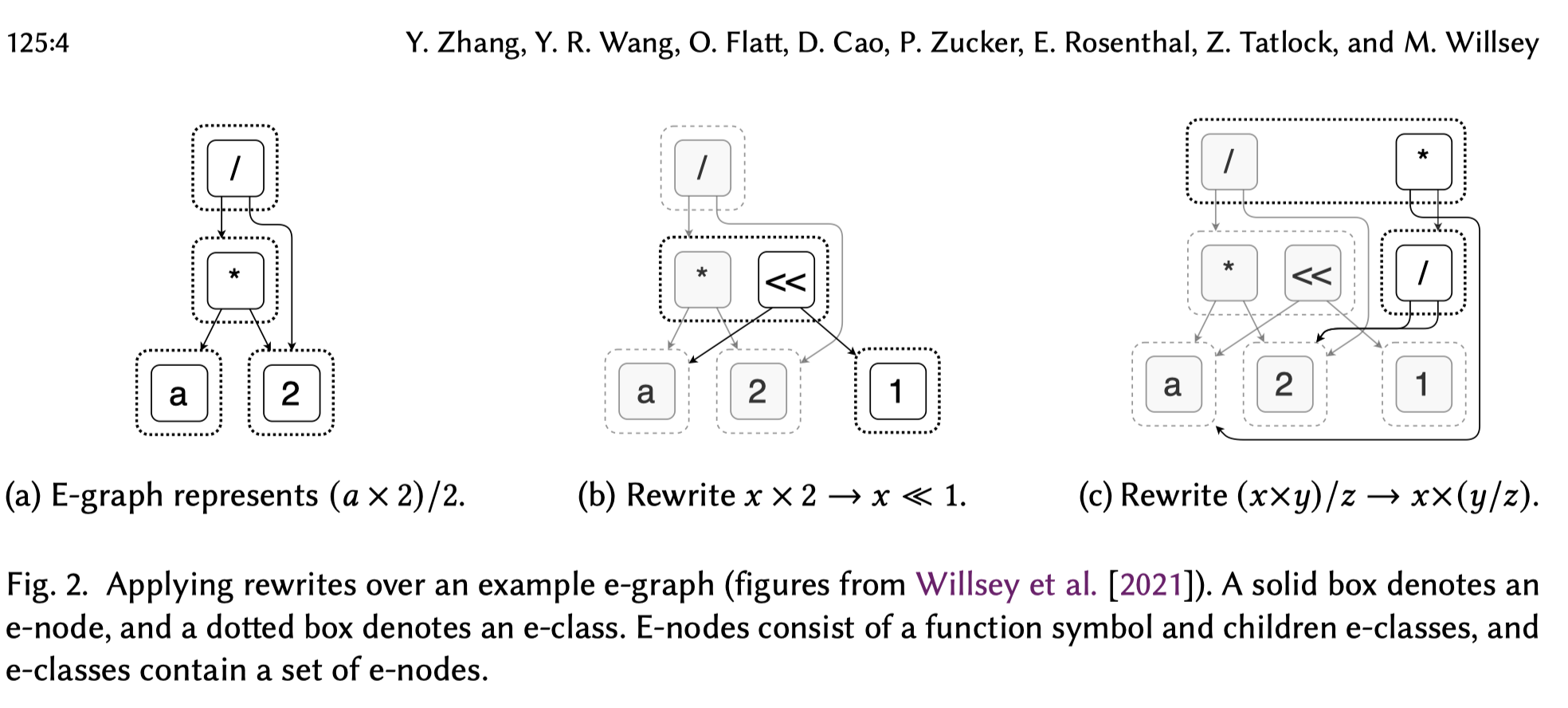
Properties:
- congruence closure: If
a = b, thenf(a) = f(b)is automatically maintained. - structural sharing: common subexpressions are automatically shared, saving memory
- canonical representation: each equivalence class has a canonical representative, making equality checking O(1)
Operations:
- union: merge two e-classes when you discover they’re equivalent
- find: get the canonical representative of an e-class
- add: insert a new expression
Exponential compression:
- : can represent exponentially many equivalent expressions in polynomial space
- eg: the expression
((a + b) + (c + d)) + ((a + b) + (c + d))with all reassociations would create thousands of equivalent forms, but the e-graph stores them compactly.
Efficient queries:
- “Are these expressions equivalent?” → O(1) after canonicalization
- “What are all expressions equivalent to X?” → Traverse the e-class
vs. other representations
- ASTs: pick one representation
- DAGs: share identical subexpressions
- Term rewriting: destructively modifies
Applications: e-graphs appears in
- egg: Rust library for e-graphs and equality saturation
- Z3: SMT solver uses e-graphs for theory reasoning
- Cranelift: WebAssembly compiler’s optimization passes
- Herbie:
- numerical expression optimization:
- takes a real expression as input
- returns the most accurate floating-point impolementation it can synthesize
- core:
- run equality saturation to explore equivalent programs
- these programs are mathematically equivalent over the real numbers, but may have different behavior over floating-point numbers.
- Herbie finds the most accurate among them
- numerical expression optimization:
- Ruler: Automated rewrite rule inference
Fixpoint reasoning framework
: a computational approach for solving problems where you repeatedly apply rules or transformations until you reach a stable state (the fixpoint) where no further changes occur
- both Datalog and EqSat belong to fixpoint reasoning frameworks
Egglog
motivation:
- efficient equational reasoning of EqSat and
- the rich, composable semantic analyses of Datalog
- make up for each other’s weaknesses
: essentially a Datalog engine with two main extensions
- a built-in, extensible notion of equality
- functions (a functional dependency from its arguments to its output, i.e., output is uniquely determined by the arguments)
:merge: a function’s:mergeexpression is used to resolve conflicts in map:- conflicts can arise in two ways:
- the user / a rule calls
(set (f x) y)where(f x)is already defined
- the user / a rule calls
unioncauses a function’s inputs to become equivalent
- essentially: user-specified functional dependency repair
- : the key technical mechanism enabling the synthesis of fixpoint reasoning capabilities of Datalog and EqSat
- conflicts can arise in two ways:
implementation:
- based on a functional database instead of a relational database:
- ie. each function / relation is backed by a map instead of a set
- benefit:
- enable efficient “get-or-default” operation
- input maps to single output
- based on a functional database instead of a relational database:
Example:
- : egglog supports classic Datalog programs like reachability written in the natural way. Functions and
:mergeallow egglog to support Datalog with lattices similar to tools like Flix and Ascent
- : egglog supports classic Datalog programs like reachability written in the natural way. Functions and
- Reachability in the classic Datalog style
(relation edge (i64 i64))
(relation path (i64 i64))
(rule ((edge x y))
((path xy)))
(rule ((path x y)(edge y z))
((path x z)))
(edge 1 2)
(edge 2 3)
(edge 3 4)
(run)
(check (path 1 4));; succeeds
- Reachability including shortest path length.
(function edge (i64 i64) i64)
(function path (i64 i64) i64 :merge (min old new))
(rule ((= (edge x y) len))
((set (path x y)len)))
(rule ((=(path x y)xy)(=(edge y z)yz))
((set (path x z)(+xy yz))))
(set (edge 1 2) 10)
(set (edge 2 3) 10)
(set (edge 1 3) 30)
(run)
(check (path 1 3));;prints "20"
- Example: Unification and EqSat in Egglog
- combining nodes with unification
(sort Node)
(function mk (i64)Node)
(relation edge (Node Node))
(relation path (Node Node))
(rule ((edge x y))
((path x y)))
(rule ((path x y) (edge y z))
((path x z)))
(edge(mk 1)(mk 2))
(edge (mk 2)(mk 3))
(edge (mk 5)(mk 6))
(union (mk 3)(mk 5))
(run)
(check (edge (mk 3)(mk 6)))
(check (path (mk 1)(mk 6)))
- basic equality saturation
(datatype Math
(Num i64)
(Var String)
(Add Math Math)
(Mu1 Math Math))
;;expr1 =2*(x+ 3)
(define expr1(Mul(Num 2)(Add (Var"x")(Num 3))))
;;expr2=6+2*x
(define expr2(Add (Num 6)(Mul (Num 2)(Var "x"))))
(rewrite (Add a b)(Add b a))
(rewrite (Mul a(Add b c))(Add (Mul a b)(Mul a c)))
(rewrite (Add (Num a)(Num b))(Num(+a b)))
(rewrite (Mul (Num a)(Num b))(Num (* a b)))
(run)
(check (= expr1 expr2))