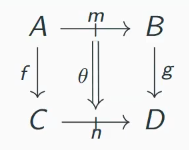
Definition
- a double category is a category with an extra class of morphisms. Together we have vertical morphism and horizontal morphism
- also, it features a collection of squares, parametrized by two horizontal and two vertical morphisms, with compatible endpoints as follows
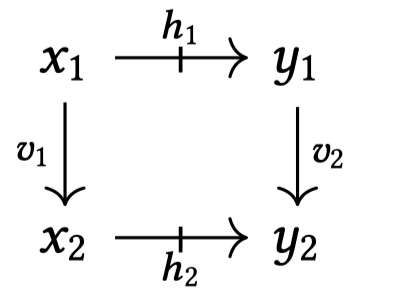
- the square is also called 2-morphism, or 2-cell
- For vertical and horizontal morphisms we have identities and morphisms
- Difference: laws for vertical morphisms hold up to equality, whereas the laws of horizontal morphisms hold up to a square.
- this means that we have unitor and associator squares that witness the unitality and associativity of horizontal composition
Different flavors
- strict double category: unitality and associativity of composition holds as an equality
- pseudo double category: composition of horizontal morphisms is only weakly unital and associative
- virtual double category: even weaker
: , a pseudo-category internal to categories
- = category of objects and arrows
- = category of proarrows and cells
cells look like
: external composition associative up to coherent isomorphism; external identity functor
Examples:
- sets and spans,
- sets and relations,
- categories and profunctors,
- rings and modules,
- metric spaces, posets
Bicategory and 2-category
- they are double category
- Any bicategory is a double category without ordinary arrows and cells with trivial external source and target
- Any 2-category is a double category without proarrows and only cells with trivial internal domain and codomain
- Likewise any double category has an underlying (2-)category (functional part) and an underlying bicategory (relational part).
- they are double category
a way to combine or synthesize the theories of functional and relational OLOGs